
Rabbi's Blog
A last story for Sukkot
The Etrog by S. Y. Agnon, adapted
[By clicking on the links you will see the original story by Agnon and other interesting things]
If you want to know how precious the mitzvah of Etrog is to the Jewish people you just need to go to Meah Shearim before Sukkot. That neighborhood, which is like a withered plant all year long, becomes pleasure garden, with stores full of etrogs, lulavs, and hadasim. Jews from all over Jerusalem crowd into those stores, inspecting the etrogs, lulavs, and hadasim, or sharing learned insights about them.
Shmuel went to purchase an etrog for himself, since you know, the worse thing in the world is a stolen etrog. It has to be yours, even if a richer friend wants to lend it to you, they need to give it as a gift. And then, of course, you gift it back to them. The worse thing in the world is a stolen etrog – because from that mitzvah you acquire riches without end, mostly they say, a son. And so Shmuel pushed his way into the shop of a seller of old books, who abandons book selling during the month or so before Sukkot in order to sell etrogs.
The shop is full of customers, and the book seller, who had become an etrogger (that is, a seller of etrogs), was busy with his merchandise. Very, very busy. He leaped from corner to corner, from shelf to shelf, pulling one etrog out of its wrapping while wrapping another etrog back up.
If a person should say, “There’s a wrinkle in this here etrog,” the book seller transformed into an etrog seller is quick to remind the buyer that this wrinkle is to the praise of the etrog, for the fruit that Eve ate in the Garden of Eden was none other than an etrog, and her teeth marks remain on the fruit in the shape of this wrinkle.
On seeing that the shop was packed, and the storekeeper preoccupied, Shmuel decided to leave. He pulled him back and said, “Wait a moment and I’ll give you an etrog that blesses those who bless on it.” He abandoned all his other customers, jumped about while presenting me with two or three etrogs; about each he asked, “Were you looking for one like this? Is this the one you desire?” Shmuel hadn’t a chance to examine them before he presented a fourth, fifth, and sixth etrog, and then the etrog seller moved to another customer. And despite the differences among the etrogs—in size, quality, and beauty—the storekeeper’s mouth had the same word of praise for each. When Shmuel finally made up his mind – so many choices! – he heard the price and set that etrog aside, to find one, well, more within his budget. You know, in Sukkot we have many other mitzvot, and none of them are free. But then the storekeeper smiled and said, “Rabban Gamliel purchased an etrog for one thousand zuz, and the sages did not even specify whether it was beautiful or not, and you set aside the choicest of etrogs on account of a few dollars?”
In a corner of the shop, away from all the other customers, stood an old man inspecting the etrogs in one of the boxes. Sometimes a person can stand in the thick of a crowd, and only one other person draws attention. This is what happened to Shmuel with that old man at that time.
When he selected an etrog he asked the storekeeper what it cost. He told him the price. Setting the etrog aside, the old man said, “That much money I do not have. Give me one cheaper than this.” The storekeeper said, “Rabbi, if you want a kosher etrog you have to pay such-and-such a price, just as Rabbi Ploni and Gabbai Almoni paid for theirs. Do you know, rabbi, how much they paid?” At that point the storekeeper named an outrageous price, while looking at the etrog and declaring it to be the very embodiment of the Torah’s ideal of beauty, strictly kosher according to all opinions. The old man replied, “Even the money, with which one purchases the etrog, must also be kosher. There is nothing worse than a stolen etrog.” Without saying another word, the store-keeper sidled up to Shmuel and asked: “Have you found one yet?”
“That man you called ‘Rabbi’—who is he?”, asked Shmuel. The storekeeper whispered, “Why, that’s the Rabbi of Teplik. I’m surprised you don’t know him. All of Jerusalem says he’s a true genius.” I told the shopkeeper, “I’ve heard his name but have never seen him face-to-face until now.”
What had Shmuel heard of him? He was a genius, very pious, but above all the rabbi of Teplik was renowned for his charitable works with the poor. The rabbi struggles with those hard-hearted and uncharitable, making them give tzedakah even when they don’t really want. The rabbi also deals with those appointed to administer the funds that are supposed to go to the poor. On account of the mitzvah of tzedakah he thinks nothing of his own honor, nor of the trouble he exerts on behalf of the needy. There are rabbis who are praised for their Torah knowledge, for their piety, their cleverness, or worldly knowledge — the rabbi of Teplik also had all these things. He was worthy to be crowned with gold and reside in splendor, but he lived in a poor neighborhood, in a small apartment, in worn-out garments, like most of the folks in Jerusalem who do not possess enough money to purchase fancy clothes. Most of his salary earned from the rabbinate was distributed to orphans and widows.
The rabbi of Teplik finally found a kosher etrog that was within his budget. He took out his wallet and paid the storekeeper. From the way he opened the wallet and counted out the money, it was clear he didn’t have much to spare.
Shmuel, too, found an etrog. He ended up splurging on that etrog, its price having been driven up by the competition for a beautiful etrog. Weary and worn, Shmuel left the etrog shop. The day before had been Yom Kippur, and despite the fact that he had spent 26 hours or more fasting and praying barefoot he hadn’t felt tired — not in body neither in spirit, but he had felt a great joy. But in those three or four hours spent in the pursuit of a kosher etrog, there was no joy and all the haggling over prices, even when it involves a mitzvah, brings one to exhaustion.
Shmuel had always been troubled by this: Mitzvot that are given to the whole of the Jewish people should be affordable to all Jews, yet some mitzvot are within reach of the rich but not the poor. Yet Torah and mitzvot were given to all Jews.
While Shmuel was still thinking about this, a certain fellow approached him, “You should wish me Mazal Tov — my wife, she should live and be well, gave birth to a son.” After Shmuel had finished with all the possible blessings for the father and the mother and the son, he asked when the brit milah would take place. He told Shmuel, “On the first day of Sukkot, following the services at the small shul of my neighborhood.”
So on the first day of Sukkot Shmuel rose extra early, washed his hands and face, entered his sukkah, recited the blessing over the lulav and etrog, had some coffee, took his tallit, his siddur, and his lulav and etrog, and headed off for the little shul of that man making a brit for his son. He rose early because of the honking of the cars, truth be told. But he set on his way.
It was a nice day, neither too hot nor too chilly. The sukkot and the lulavs he saw in his way perfumed the air of his journey. After a bit more than an hour walk he arrived in the neighborhood where the brit would take place.
That neighborhood was quite impoverished, with neither nice homes nor maintained streets, gardens, or orchards to please the eye. Yet it was quiet. No cars at all, and from a few sukkot could be heard the sound of Torah study. Out of love for the mitzvah of sitting in the sukkah, some of the people sat learning Torah outside. The sukkot, with their leafy green roofs, made the neighborhood look like a beautiful garden, while etrogs and hadasim gave off a pleasant fragrance, and the decorated cloth sukkah walls added beauty to the scene.
Shmuel entered the little shul, set his lulav down on the windowsill, took a book from the shelf, and sat down to learn. The shul was empty but for one old man, who stood bent over at the bookcase looking at a book. After a moment old man returned the book to its place and began pacing about like one troubled by a difficult matter.
As he was pacing he passed the windowsill where Shmuel’s lulav and etrog rested. He looked and asked permission to see the etrog. Upon examining it he declared, “Kosher, kosher.”
Shmuel then remembered who the old man was. It was the rabbi of Teplik! Shmuel also remembered what he had said about the officials who waste communal funds to acquire beautiful etrogs for themselves. His exact words were: “Even the money used to buy the etrog needs to be kosher, that is, ‘kosher money’ is more important than adding to the beauty of the mitzvah. There is nothing worse than a stolen etrog.”
While Shmuel was thinking about the meaning of those words, the rabbi of Teplik said to him: “I would like to perform the mitzvah with your etrog.” Shmuel said to him, “It is given to you as a gift.” After he recited the blessing, the rabbi also gave the etrog back, as a gift.
Shmuel then asked: “Rabbi, where is your etrog? You bought a lovely etrog, and with kosher money too, I saw when purchased it.”
He gazed at Shmuel with large and lovely eyes, in which you could see wisdom and innocence, and he said, “You were there when I bought my etrog? Indeed, a kosher etrog it was, but something happened to it. But why are you standing?” Shmuel said to him, “If the rabbi doesn’t sit, I don’t sit either.” He said, “I am used to standing, but so that you need not stand, I will sit.”
The rabbi sat, Shmuel sat, and the rabbi told the story: “In my neighborhood there resides a certain baal-ha-bait, a certain houseowner. A tough, angry, irritable man, but careful about mitzvot. He bought an etrog for at least 80 dollars, maybe more. He bragged about it in front of his neighbors, that there was none finer. I’m not sure how beautiful it really was, but there’s no one in this neighborhood who can afford to buy an etrog for 80 dollars. This morning I heard a sound of crying coming from his house. I told my wife ‘I hear the neighbor’s child crying, go see why she is crying, please.’ My wife returned and said: ‘The girl was playing with the etrog her stepfather bought for eighty dollars, the etrog fell from her hand, broke its pitom and became invalid for the mitzvah. Her mother smacked her. That poor woman knows what’s in store for her from her husband on account of her daughter from her first marriage.’ I asked my wife: ‘Where is he now?’ She said: ‘He ran to the mikveh to immerse prior to taking the lulav. If he’s come out of the mikveh, he must be sitting in the sukkah of the Rebbe of Zvhil, to watch and learn as he waves the lulav, for his waving is like that of his father, who received the tradition from his father, and his father from his father back to the Maggid.’ I then ran and took my etrog to the girl and said to her: ‘Don’t cry. Here is my etrog, give it to your mother. If your father asks, have your mother tell him: The rabbi was here and saw that your etrog was not kosher. To enable you to perform the mitzvah properly, he gave you his etrog as an unconditional gift.’ It was because of that trouble that I didn’t have time to recite the blessing on my own etrog.”
The rabbi added, “You know, there’s nothing worse than a stolen etrog. The etrog must be kosher, but the money that purchases the etrog must be kosher also!”
A story for Sukkot I
This is a story about a Rebbe who became famous, but he didn’t really want the fame. He was fine being a complete unknown disciple of the Baal Shem Tov. His name was Reb Pinchas of Koretz. All that Reb Pinchas ever wanted to do was to study, pray and meditate – alone.
But then, the word began to spread, no one knew exactly how, that Reb Pinchas was very, very special. People began to visit him on a regular basis, wanting his guidance, begging for his support, asking for his prayers and his blessings.
Wherever he went, he was surrounded. He would walk to the synagogue early on Shabbat only to have three or four students ask him a question on the way. As he sat in the synagogue praying, children would come and sit in his lap. When he rose to teach, the community showed up en masse. And when he went home, there were a dozen women with a dozen kugels, waiting for him. “Taste this kugel, Rebbe, and give me your blessing!”
What could he do? He carefully tasted all twelve kugels, and dutifully pronounced twelve blessings: “May your life and the lives of your children be as sweet as this wonderful kugel!”
On holidays, even more people came, especially on Sukkot. Sukkot is called zman simchateinu, the season of our joy. They said: If you haven’t celebrated in the Sukkah of Reb Pinchas, you don’t know true joy! So many people, students, children, housewives, followers!
But despite all this, Reb Pi nchas was bothered. He wanted to pray, study meditate and maybe even write a great book. But how? He had no time! He was always taking care of someone, answering someone’s question, offering someone a blessing. He was always being the Rebbe. When could he sit alone?
As time went on, this bothered Reb Pinchas more and more. He needed more privacy and less distraction, but how could he turn away all these people who genuinely felt that he could help them? How could he convince them to go elsewhere, to others more willing and qualified than he?
So one Yom Kippur, Reb Pinchas made a request from the Holy One: “Take all these people away from me! Day and night they pester me. Day and night, I listen to their needs. Give me quiet! Give me peace to sit and meditate, and pray and study! Let no one bother me!”
“A tzaddik decrees and Heaven agrees,” – so God heard the prayer, and said “OK.”
When Yom Kippur was over and the shofar sounded, no one invited Reb Pinchas to break the fast. Not only that, one could tell that he was met with averted heads and a chilly atmosphere. There were no crowds of people, no platters of food, no plates of treats to fill Reb Pinchas’ home after Yom Kippur. Instead, Reb Pinchas walked home alone and for the first time in years broke his Yom Kippur fast alone with his wife.
It was the best night of his life, he thought. He was able to meditate and study without being interrupted.
But the next morning, everyone in the town was busy putting up their sukkot for the coming holiday. Reb Pinchas waited for the men of the town to come with their tools and put up his sukkah. But no one came. A second day passed, and then a third. No one showed up.
Not being handy in these matters, the Rebbe didn’t know what to do. Finally, having no choice, he was forced to hire a non-Jew to build the sukkah for him. But the hired man did not possess the tools that were needed, and Reb Pinchas could not get a single neighbor to lend him tools because they disliked him so much. In the end, his wife had to go to borrow them, and even that was difficult because no one liked her husband. With just a few hours remaining until the festival, they finally managed to complete a flimsy minimal structure, ugly and crooked.
As the sun set and the Rebbetzin lit the candles, Reb Pinchas hurried off to shul. He never missed a service on holidays, and besides he didn’t want to miss the opportunity to acquire a guest for the festival meal, something so basic to Sukkot.
In those days the poor people or travelers passing through a community would stand in the back of the shul when services were over, so the townspeople could invite them to their homes. This way everyone was happy: the poor or the travelers were happy to have a warm meal and possibly even a bed, and homeowners were happy to do the mitzvah of hospitality so easily.
But not Reb Pinchas. Even those without a place to eat and desperate for an invitation to a sukkah turned him down. Eventually, everyone who needed a place and everyone who wanted a guest were satisfied, except for Reb Pinchas.
And so the first night of Sukkot arrived, and Reb Pinchas sat in his sukkah, alone with his wife. No one came to celebrate. No one brought treats. No children, no laughter, no song. It was quiet. And Reb Pinchas thought to himself: this is the price of freedom. It is worth it. Right?”
But then came the moment of inviting the Ushpizin, the Holy Guests of Sukkot. And Reb Pinchas was such a great rebbe that he was actually able to see them, their shining presence right there. So he began his meditations to receive the Holy Guests.
But this year, when he opened his eyes and he saw all of them – Abraham, Isaac, Jacob, Joseph, Moses, Aaron, David — they would not come into the Reb Pinchas’s sukkah. All of them were standing outside the door of the sukkah, keeping their distance.
Reb Pinchas cried out: “Abraham our Father! Why don’t you enter my sukkah?”
And Abraham said: “How could I? Your sukkah has no guests. I am the embodiment serving God through loving-kindness. Hospitality was my specialty. I will not join a table where there are no guests. In your sukkah my people are not welcome. how could any of us come in?”
Reb Pinchas began to cry. He threw himself down on the ground and wept and prayed aloud.
“I am sorry. I have made a terrible mistake. Bring me back my people. Bring me back my students. Let them come and fill my life again. Please accept my prayer.”
God heard the prayer, and asked Reb Pinchas, “Is that what you really want? You know they will bother and pester you until the day you die, and you might never write a book. You might never have time alone.”
“Yes!” responded Reb Pinchas, “Let them come and bother me, pester me all they’d like! Let them come and fill my life with all their needs! They are my blessing! Just bring them back to me… I need them.”
“A tzaddik decrees and Heaven agrees,” – so God heard the prayer, and said “OK.”
Before Reb Pinchas could even pick himself up, there was knocking at the door of the house. The whole town came to Reb Pinchas’ sukkah. They came to his crooked, ugly sukkah. They brought platters and plate of treats for the feast. They brought learning. They brought questions. They brought laughter and song. They brought life.
And Reb Pinchas enjoyed every minute. Every question, every request for a prayer or a blessing, every child’s song brought him joy. He enjoyed that Sukkot holiday more than all the others put together. And the next year, he enjoyed Sukkot even more.
At the end of the day, Reb Pinchas never did write a great book. We don’t know if he was ever able to meditate again, or pray alone, or serve God in loneliness as before. But he is remembered forever for his joy. They still say: If you haven’t celebrated Sukkot in the sukkah of Reb Pinchas, you don’t know true joy!
This is a story for all of us who are tired emails and texts and calls. Tired of friends who ask for our time, coworkers needing to vent, family demands that are unending. May we all remember that serving people and loving them are ways of serving God and loving God. And in the process, may we accept being loved by them as well.
Sukkot ~ Let’s have a little fun ~ 1
This is a poem of all the laws of Sukkot, Dr. Seuss style! If you have any doubts, check the footnotes.
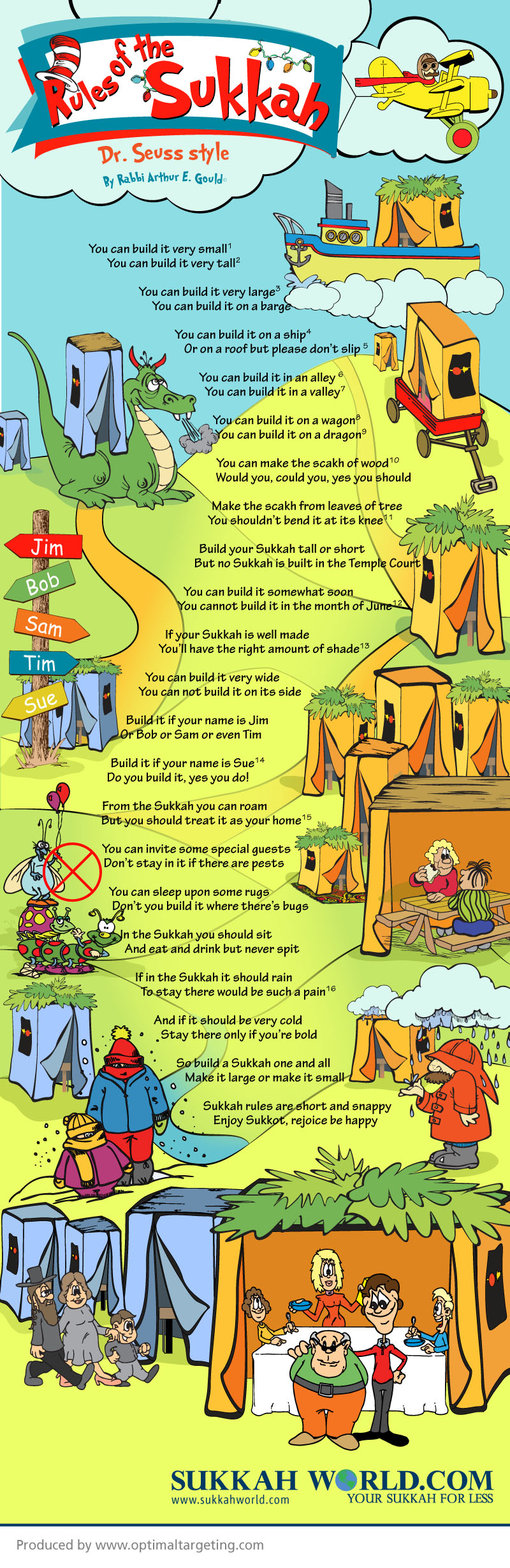
Click here to download a pdf: rules-of-the-sukkah-printable
1. Maimonides (RaMBaM) Mishne Torah, Hilchot Sukkah, Chapter 4, Section 1. The minimum height of a Sukkah is 10 tefachim. A tefach is a measure of the width of the four fingers of one’s hand. My hand is 3 1/4 inches wide for a minimum Sukkah height of 32 1/2 inches. The minimum allowable width is 7 tepachim by 7 tepachim. This would result in a Sukkah of 22 3/4 inches by 22 3/4 inches.
2. The maximum height is 20 Amot. An Amah is the length from the elbow to the tip of the middle finger. My Amah is 15 1/2 inches for a maximum height of 25 feet. Others say that 30 feet is the maximum.
3. According to RaMBaM the Sukkah can be built to a width of several miles. Shulchan Aruch also says there is no limit on the size of the width.
4. RaMBaM Hilchot Sukkah Chapter 4, Section 6.
5. RaMBaM Hilchot Sukkah Chapter 4, Section 11. RaMBaM states that one may construct a Sukkah by wedging poles in the four corners of the roof and suspending scakh from the poles. The walls of the building underneath are considered to reach upward to the edge of the scakh.
6. RaMBaM Hilchot Sukkah Chapter 4, Section 8-10 discusses the ins and outs of building your Sukkah in an alley or passageway
7. There is a location referred to in the Talmud called Ashtarot Karnayim. According to the discussion there are two hills, with a valley in between where the Sun does not reach. Talmud Bavli, Sukkot 2a. The halacha is that you can build your Sukkah in Ashtarot Karnayim, or other places where the sun does not reach the Sukkah because of artificial impediments, provided that if the impediment were removed, shade from the sun would now come through the scakh.
8. RaMBaM Hilchot Sukkah Chapter 4, Section 6. You can go into a Sukkah built on a wagon or a ship even on Yom Tov.
9. RaMBaM Hilchot Sukkah Chapter 4, Section 6. OK, RaMBaM says a camel but dragon rhymes with wagon a lot better, don’t you agree. Anyway, RaMBaM says you can build your Sukkah on a wagon or in the crown of a tree, but you can’t go into it on Yom Tov. There is a general rule against riding a beast or ascending into the crown of a tree on Yom Tov.
10. Chapter 5 deals with the rules for the skhakh. Basically, you can use that which has grown from the ground, and is completely detached from the ground. So, for example, you cannot bend the branches of a tree over the Sukkah to form the skhakh. But you can cut the branches from a tree and use them as skhakh.
11. This would be a violation of the rule cited in the prior footnote.
12. Shulchan Aruch, Hilchot Sukkah, Perek 636, Section 1 The Sukkah should not be built sooner than 30 days before the Hag. However, if the structure is built prior to 30 days, as long as something new is added within the 30 days, the Sukkah is kosher.
13. Of course it’s a well known rule that you must sit in the shade from the roof of the Sukkah and not in the shade that may be cast by the walls. It seems that this might affect the height of the walls, depending on the longitude of the location where you are building your Sukkah.
14. Traditionally, women, servants and minors are patur (exempt) from the Mitzvah of Sukkah. In our day we hope we know better than to read out half the Jewish people from the observance of Mitzvot. Of course, that’s just a personal opinion of the author.
15. RaMBaM ibid Chapter 6, Section 6 explains that you should eat, drink and live in the Sukkah for the 7 days as you live in your own home. One should not even take a nap outside of the Sukkah.
16. RaMBaM ibid, Section 10 If it rains one should go into the house. How does one know if it is raining hard enough? If sufficient raindrops fall through the skhakh and into the food so that the food is spoiled – go inside!
Credits: Rules of the Sukkah by Rabbi Arthur E. Gould
Don’t tame the Leopard
Main idea: teshuvah is a dual process, looking inward and outward; getting rid of the things we detest
Franz Kafka has a two-sentence short story. It goes like this:
 “One day, a leopard stalked into the synagogue, roaring and lashing its tail. Three weeks later, it had become part of the liturgy.” The story tells the tragic tale – the lashing, roaring tale – of all organized religion, not just Judaism. It is the tale of how we cage revelation into a recitation, and think we have done our job, that we are religious people. Even when we practice we do it by rote, taking our heart out of it. The leopard is locked into the cage of liturgy.
I say this to prepare ourselves. In a moment, Isaiah will be speaking moved by God’s command: raise your voice like a shofar, shout the transgression of My people and their sin!
Isaiah’s words are the leopard.
And Isaiah has crashed into our fast, at this very moment in our fast, when our stomachs actually growl with hunger and our mouths begin feeling dry, when we feel faint and have headaches of caffeine withdraw, Isaiah tells us that focusing on our hunger, our thirst and our headache is completely and absolutely missing the point.

Who are we kidding, asks Isaiah, by pretending that we are a nation that does what is right, by pretending we have not abandoned the ways of justice, given by God? That we should stand here, at this moment, and say to God: look at me! I’m fasting!
Isaiah wants to move us from our self-absorption. He sounds outraged, full of righteous indignation and sad, all at once.
Who are you kidding, the prophet asks! The fast that is desired is the fast of oppression, of greed, of indifference!
Isaiah continues: God will only answer us if we banish violence from our midst, expel the menacing hand and evil speech, give food to all hungry.
This is basic teshuvah, collectively and individually, spelled out by Isaiah, even though he does not use that word. Why should he? This is Yom Kippur, the day for teshuvah, return! Isaiah, walking into a Yom Kippur sneers at people “drooping their heads like bullrushes.” He demanded that they pay attention to the poor, to those in prison, and also to their own scrabbling for wealth.
Have we changed that much in 2,820 years?
Look at the prophet in the eyes: can you say we banished violence from our midst? Who are we kidding, we, who live in a country where every day, more than 100 people are killed with guns and 200 more are shot and wounded?
Look at the prophet in the eyes: can you say we banished evil speech from our midst? Who are we kidding, we, who live in a reality where from every screen and every speaker words demonizing others, falsehoods, lies come to meet us.
Look at the prophet in the eyes: can you say we have clothed the naked? That we fed the hungry? Who are we kidding, we, living in a country with 140 million poor and low-income people, with 38.5 million of them being children? A country in which 1.5 million public school students experienced homelessness this year alone?
Look at the prophet in the eyes: can you say we have unlocked the fetters of wickedness? Who are we kidding, we, living in a country with around 52,000 immigrants confined in jails, prisons, tents and other forms of detention – most of them for profit. 13,000 of those are children. We, who have the biggest incarcerated population in the world, around 2 million people.
Look at the prophet in the eyes: can you say we have broken the yoke of oppression? That we did not work on our holy days, and did not oppress our laborers? Who are we kidding, us, with stuff made by children in India and prisoners in China and in the US? Who are we kidding, us, living in a country where CEO compensation has grown 940% since 1978 whereas the typical worker compensation has risen only 12% during that time?
Teshuvah means return. This is not just a return of the religious type, mitzvot or good deeds, prayer or inspection of actions – but rather, it is supposed to be a return to the place we belong. The return to our home. That is why in the middle of a pandemic we are here, in a sanctuary, we crave to be back home, to feel that we are connected. The return to godliness is like the return to the foundation, to home base of who we really are. Because deep inside of you, of me, of every single human alive, there is a spark of God’s presence, begging, cajoling, nagging you to be better and to make this world better.
According to Rebbe Kalonymus Kalman Shapira, the Piaczeczna rebbe, who was murdered by the Nazis, all your thoughts of teshuvah, of return, of becoming better, of making this world a better place, all of those – that is actually the voice of that spark.
Because G!d’s voice is actively asking to be revealed in this world through you. You are the revelation of G!d, if you allow that to come out.
And he goes on: even your worries, money, job, children, grandchildren, politics, the state of public education, firearm regulation, democracy: all of it, all of it is G!d’s voice begging you to let G!d’s presence come out in this world. And this is precisely because every single one of us perceives that voice through our personality and our particular traits.
Now if you heard anything else from Isaiah, you heard that we are supposed to be a light to the nations. It is a beautiful image. But we have forgotten our call. We have been mired in distractions and accumulation of stuff, completely unaware of our mission to be a light to the nations.
We have separated ourselves from the rest of humanity, even from those whom we share a house with, and have been swallowed up by our screens, our iPods, iPhones, iPads, everything making us believe it is “I” that matters and no one else. Every single one of us walks in a darkness that we ourselves have made. We bought that darkness, that despair, that disconnect.
Teshuvah means return. A life without teshuvah is not really a life, because it is a unexamined life, a unchecked life, a life lived unawares, like the life of an ant on a paper boat in the sea at night, buffeted here and there by winds and waves with nothing to guide or to save. The ant is not even aware of its complete and utter helplessness, doesn’t even know of the lack of direction.
The first step of teshuvah is to decide not to be an ant on a paper boat in the sea at night. It is to decide to be intentional about where your life is going. To examine, check and be aware. Only then you will see the sea, and maybe find yourself in a boat with a helm.
Isaiah knows of evil people. The wicked, he tells us, never rest, like the stormy sea. Haven’t we seen that this very year? It has been hard to keep track of what is the latest cruelty perpetrated, the last corruption and the last power grab, because as soon as one happens, and we turn to try to digest it, we are confronted by three more. The wicked never rest.
But Isaiah has a promise: make those changes and you will be removing the obstacles in your road, in your road to return, to teshuvah.
Teshuvah means return. It is only when we live a life of meaning, a life that sees beyond its immediate desires, a life that is devoted to the community and to the larger American and human communities, that we will be able to see our light burst amid darkness. That is true to all of us, rachok vekarov, those close by and those far away.
When we see arrogance in the news, let’s not just yell but also vow to be more humble.
When we see violence, let’s not just point fingers but also address the causes that make people feel they have nothing to lose.
When we see bullying from politicians, let’s not just get mad but also pledge to be more compassionate.
When we see corruption, let’s not just shake our heads but also apply pressure to get corruption addressed, punished and curbed.
When we see blatant lies, let’s not just shrug our shoulders but also commit ourselves to living a life that honors truth, science, reality and numbers.
When we see greed, let’s not just scream but also locate the greed in us that needs to be addressed.
When we see racism, sexism, homophobia, xenophobia, hate, prejudice and bigotry, let’s not just protest but also work to uproot those evils within ourselves.
Because teshuvah is an inward-looking movement about ensuring we become the opposite of what we detest in the world, and also an outward-looking movement to uproot the evils we see in the world.
Heschel said: “Prayer is meaningless unless it is subversive, unless it seeks to overthrow and to ruin the pyramids of callousness, hatred, opportunism, falsehoods. The liturgical movement must become a revolutionary movement seeking to overthrow the forces that continue to destroy the promise, the hope, the vision.”
This year, look the prophet in the eyes, raise your hand and say “hineni” – here I am. Make your fast meaningful. Make your prayer meaningful. Do not let the end of the day and the recitation of the words tame your leopard. Make this year, through your actions, be a good year.
G’mar Chatimah Tovah, may we all be inscribed in a good year.
Kol Nidrei – thoughts

Main idea: the greatest thing in the world is to do someone else a little favor / the power of words
Welcome everyone to our Kol Nidrei Services.
I want to thank everyone who has been instrumental on giving us this possibility. Even though we are socially distanced and are wearing masks, we are spiritually and emotionally close. Here we can feel the presence of community, of the many women and men that made Adath Israel become what it is, and we, ourselves, are here, making community happen in times that are difficult and strange, even though not unprecedented. Our people has survived many plagues, in different times and places, and – the moment is ours, to paraphrase the Fiddler on the Roof – maybe that’s why we always wear our masks.
We are all here with one goal – to get through Yom Kippur. Many people prefer to focus on the fact that they won’t be eating or drinking for the next 25 or so hours.
For most, that is an accomplishment on its own, and I am not diminishing it. It is hard. But that is not the essence of YK. YK is all about working – hard – on ourselves and on the power of our words, and our small actions.
One of the most repeated prayers of YK is the confession [sing]… ai, ai, aii…ashamnu, bagadnu… we will say it ten times during those 25 hours. We all know the tune. But have you stopped and paid attention to the words? It’s almost all about the use of speech and words – we betrayed, spoke slander and ugly words, gave bad advice, lied, made fun, made up falsehoods, blasphemed, swore falsely, oppressed, corrupted, cheated and mislead.
Words, in Judaism, are seen to have an immense power. We all know, we all have felt this in the deepest of our beings: words can sap someone else’s strength and self confidence like that [snap of fingers]. Words also can build up someone like that [snap of fingers]. The right words, said at the right time, said enough times, can give someone strength to go through the most hellish of all experiences, and still come back whole. We are rarely aware of the power we have.
One of my favorite stores about words is one I heard from Reb Mimi Feigelson, who heard it from Reb Shlomo Carlebach z”tzl. It is also the story about one of my favorite sources of wisdom, Reb Kalonymus Kalman Shapira of Piaczeczna.
When the Nazis got to Poland, the rebbe and his followers ended up in the Warsaw Ghetto. Now, Rebbe Kalonymus Kalman wrote several books, and one of them while in the Ghetto. It is called Esh Kodesh – the Holy Fire. He knew that he would not survive so he buried all the manuscripts of his books in the ghetto where they were found after the war.
Before the war and during the Ghetto years, he had a yeshiva. But in his yeshiva you did not find young adults – you’d find children. He used to say, “My followers eat on Yom Kippur. You know why – they are not bar mitzvah yet.” A great Rabbi would come to him accompanied by a boy, or an older man bringing in tow a little girl of four or five. He would say to the older person, “You’ll make it without me. This child needs me.”
With older people he would spend five minutes; with children all night. And he had thousands of kids that he taught and guided and helped. He was their father, their mother, their best friend. After the war, there was nobody left.
Now, Reb Shlomo Carlebach is probably the responsible for Reb Kalonymus Kalman Shapira’s books being translated into English, since he talked about them a lot with his many followers. But his whole life Shlomo Carlebach dreamt and hoped to meet one of the children that studied with Reb Kalonymus Kalman Shapira.
You, reading this online, can hear Reb Shlomo tell the story here: https://www.youtube.com/embed/KQwksf6ZslY
And once he was walking on the Yarkon in Tel Aviv and he saw a hunchback – a street cleaner. Reb Shlomo had a feeling this person was special. He was a real hunchback, in that his face was very handsome, but every part of his body was disfigured. And Reb Shlomo said to him. “Hey, shalom aleichem my friend.” And he answered Reb Shlomo in a very heavy Polish-Yiddish Hebrew, “Aleichem shoolum.” Reb Shlomo said to him in Yiddish, “Mein zeisse yid, my sweet Jew, where are you from?” He said, “I’m from Piaseczna.” Reb Shlomo said “Piaseczna. Gevalt! Did you ever see Reb Klonymus Kalman?”
“What do you mean, did I ever see him? I was a student in his yeshiva from the age of five to eleven. I was in Auschwitz for five years. I was eleven when I got there. They thought I was seventeen; I was so strong. They beat me up so much I never healed. That’s why I look this way.
I have nobody in the whole world, really nobody.” Reb Shlomo said to him, “You know something – my whole life I have been waiting to meet one of the students of Reb Klonimus Kalman. Would you be so kind to give me over one of his teachings?”
He kept on sweeping the street, “You really think that after five years in Auschwitz, I remember any teaching?”
Reb Shlomo said, “Yes – the words of the heileger Rebbe penetrated you forever.” He stopped sweeping. He looked at me and said, “Do you really want to know?”
He touched Reb Shlomo so deeply and although you shouldn’t swear, Reb Shlomo said to him “I swear to you, and I mean it with all my heart, that whatever you tell me I shall tell all over the world.” You know he was a real chasidisher Yid. He put the broom against a wall and went to wash his hands.
When he came back, this is what he said: “There will never be a Shabbos as by my holy master, my heiliger Rebbe. Can you imagine – hundreds, sometimes thousands of young people dancing with the holy rebbe in the middle. What a sight! Not until Moshiach is coming. Can you imagine the Rebbe making kiddush sitting with hundreds of children, with so much holiness? He gave over teachings between the fish and the soup, between the soup and the meat, between the meat and the dessert and after every teaching, he would always say, “Kinderlach, taire kinderlach, my most precious children, gedenkst shon, please remember, die greste sach in die velt ist, tun emetzin a tova, the greatest thing in the world is to do somebody else a favor. ”
When I came to Auschwitz, I knew my whole family had been killed and I wanted to kill myself.
Each time I was about to, I suddenly heard the Rebbe’s voice saying to me, “Gedenkst shon, please remember the greatest thing in the world is to do somebody else a favor.” Do you know how many favors you do in Auschwitz? People dying, people crying; nobody had the strength even to listen to their stories anymore. Someone drops a potato and you pick it up and give it back to them. Someone is crying, you give them a shoulder. A few weeks later I wanted to kill myself again but always at the last moment I’d hear my Rebbe’s voice “Gedenkst shon, please remember the greatest thing in the world is to do somebody else a favor.” Now I’m here in Tel Aviv, but believe me, I’m all alone, there are moments when I decide to commit suicide. I go into the sea until the water reaches my nose. Then suddenly I hear my Rebbe’s voice again “Gedenkst shon, please remember the greatest thing in the world is to do somebody else a favor.”
And I run back to the streets. Do you know how many favors you can do on the street? A little girl loses a ring, and she is crying, and I found the ring while I was sweeping the street, and I give it back. Someone is alone, and you ask them what time it is, and we begin talking. There are so many favors you can do on the street.”
This happened to Reb Shlomo before Rosh Hashana. After Succot he came back to Israel and the first morning he went to the Yarkon and asked the people on that street where the holy hunchback was. They said he died on the second day of Succot. And Reb Shlomo would finish this story by saying that when the Messianic times arrive, that holy hunchback, the holy street cleaner will come back. He will clean the streets of the world. Do you know how he will clean the world?
He will go from one corner of the world to the other and he will say, “Yiddelach, gedenkst shon, the greatest thing in the world is to do somebody else a favor.”
The impact of words cannot be stated more clearly. Did Rebbe Kalonymus Kalman know that one day, this one encounter with the holy hunchback would inspire Reb Shlomo to find and tell everyone about the teachings of Piaczeczna? Did he know that by reminding his students, his children, that the greatest thing in the world is to do someone else a little favor, he would actually pull out his student from the throes of despair and depression?
And we have to ask ourselves, after all, this is YK: What would have happened if Reb Shlomo was too late for something to give the kind words to the holy hunchback, or if he just saw what I imagine many people just saw – a poor hunchback sweeping the streets, a street cleaner that deserves none of your attention and even less of your time?
Now, on Yom Kippur we are supposed to remember the impact of our actions – and our words. And the impact of our lack of actions, and our lack of words.
When we say the Ashamnu, we are invited to actually review the small moments, those that might have been our smallness talking or behaving, too. We are asked to review not only actions, but words, and how our words made people feel.
Being aware, asking for forgiveness and giving forgiveness to others is the essence of Yom Kippur. We all want another chance – we need to give that to each other.
And how do we do that? How do we fix having diminished people during the year, or having allowed others to feel diminished without speaking up against whoever was diminishing them? After all, saying “I’m sorry” just goes so far. You can’t put the self esteem back in to the person just by saying I’m sorry – but it is a start.
The problem is that it is very easy to give up on others, and even easier to give up on ourselves. To have the guts to really begin again, THAT takes a lot of inner strength. And this strength can only be given and received as each and every one of us look for moments that can become great – even when they look small.
A smile. A “thank you”. A card. A call. All small actions that can make someone’s day. COVID has taken away the easiness with which we would walk around and smile, but it has not made it impossible. We have phones, cameras, Zoom, Skype and God knows how many platforms enabling a little bit of contact. We have masks but we still have our smiles. What COVID did not take is the ability of having an open heart to others, and a desire to make their burden a little lighter. That, nothing can take away – only us, ourselves, can do that.
Really meeting people, being open to their brokenness and being open about our own – that is what makes those small moments magical ones. We have an inordinate amount of possibilities to actually have encounters, to actually give the strength to each other to begin again.
So I’d like to ask that please, give your neighbor, your companion, your friend, your co-worker, you mate, your children – give them strength. A little hizzuk goes a long way. We rarely if ever offer compliments to our co-workers. Say nothing of thanking them.
Embedded as we are in individuality, in the race to prove ourselves better than others, in the despair to have more than what we need, in the desire to find meaning in possessions, we forget easily that none of our existence and our work in the world is accomplished alone.
Most of all, the ones who need us most – our children, our partners, our parents, our siblings – rarely receive enough words from us.
All of our prayers can be divided into three groups: thanks, I’m sorry and I love you. Whichever page you open in our machzor you will find one of those ideas: gratefulness, apology and need.
And why do we repeat that over and over? Maybe it is because if you really mean “thanks, God” – it will be easier to thank your coworkers, your spouse, your children, your siblings, your parents, your friends. Maybe if you say enough times “I’m sorry, God” you will eventually work up enough nerve to say “I’m sorry” your coworkers, your spouse, your children, your siblings, your parents, your friends. And maybe, just maybe, if you say “I need you, God” enough times, you will eventually get over your own vulnerability and say “I need you” to your coworkers, your spouse, your children, your siblings, your parents, your friends.
How many relationships would have been saved if people would say more to each other: Thanks. I’m Sorry. I need you.
This Yom Kippur, and this year of 5781, may we all be aware of the impact of our actions and words, and may we all give new chances, to ourselves and to others – and may we all give and receive back strength to do just that: actually take the new chances we are given to become more open and do to everyone little favors.
G’mar Chatima Tovah, may we all be inscribed in the good book, in the book of goodness and of little favors.
Write the letter
Sit down. Turn all the screens off. Turn your phone off. Write the letter.

Rosh Hashanah 5781 ~ Day 2 ~ Thoughts

Main idea: our tradition has a framework about idolatry that can be helpful for us to understand how to deal with the question of Confederate statues in America – arrogance and anger
RH is the day when we talk about sins. One of the greatest sins in Torah is idolatry, as probably even the most distracted student in Hebrew school knows. But bowing down to an idol, a statue, is not something that we are likely to do nowadays, is it? Well, hold on to your pews: I want to talk about idolatry because there have been a lot of talk regarding statues lately, particularly in the South, but also regarding the statue of Teddy Roosevelt in the front of the Natural history Museum in New York. And our tradition can help shedding light on these issues.
What defines idolatry?
In Torah, idolatry is defined by the existence of a belief in a power that is not God, and that power is representable with an image, whether a statue, a painting or something else.
This idol, when properly taken care of, controls nature and human behaviors for the advantage of the follower. It is a form of manipulation of reality, of people and of nature.
Many of us believe that the laws regarding idolatry really do not apply to us anymore – after all, most Americans are not idolaters, we are Jews or Christian or Muslim or nothing. If we think about idolatry at all, we tend to reimagine idolatry as the blind following of money, status, or a charismatic person in detriment of higher values and intimate relationships. Those are all real forms of idolatry, do not get me wrong. But this is a step above the initial idea of idolatry.
Idolatry stays in human consciousness for millennia as a system connected to images.
We all know that images are powerful. An image is worth one thousand words. And an image well placed in space and time is worth ten thousand words. Polytheistic idolatry gets that – think about the gods of the Romans and the Greeks, and the great sculptures that survived to this day, and where they were placed.
Several thousands of years after the Torah kernel about idolatry, the Talmud will discuss it in detail, as it discusses everything in detail.
One of the questions it raised is – what is idolatry and what is decoration? At a certain moment, even the Greek and Roman pagans are using their own statues as decoration and not necessarily worship. The example given is a bathhouse in which a statue of Aphrodite is set in. Can a Jew still use that bathhouse? The answer might surprise you: yes. Why?
Because no one says “let’s make a bathhouse for Aphrodite, they say ‘let’s make an Aphrodite for the bathhouse”. So statues can be just decoration, or they can be something else entirely.
So let’s talk about that “something else entirely:” the rabbis will connect idolatry to two human feelings and ideas. Arrogance is the first one: God and the arrogant cannot dwell in the same place, because an arrogant person leaves no space for God, given that they are so full of themselves – the arrogant person, the Talmud says, is like someone who worships idols. Why? The idea is that self-worship, putting yourself above all other humans, is idolatrous itself. After all, Genesis tells us we are all created in God’s image. So any time you hear someone putting down some one else because of how they were created, beware – this is idolatry, just disguised in arrogance.
A famous story in the Talmud is about a rabbi, who is full of himself because he studied so much Torah. That rabbi sees a hunchback, who greets him with “Peace upon you, my teacher and rabbi” – a very proper and educated greeting. But the rabbi says back “oh, you empty one! Are all the people in your town as ugly as you?” To what the hunchback, obviously used to this kind of treatment, but hurt nonetheless to receive this from a rabbi, answers: I don’t know. But you can go ask my Maker and complain about the ugly vessel He made!”
The rabbi immediately realizes his sin, throws himself on the floor and begs forgiveness.
Why? Because being an obnoxious arrogant person, the rabbi knows, is tantamount to being an idolater.
Anger is the second feeling connected to idol worshiping in the Talmud. It is similar to arrogance in that you see yourself as the center of the universe; it is different than arrogance in that you can be consumed and controlled by anger, which most often leads to destruction. Anger can make you destroy things, relationships, and human lives. It can make you say and do things that, weren’t you under the control of anger, you would never do. Anger can also become a form of manipulation since it is used to intimidate and submit others – this is particularly true in abusive relationships, but more and more we see people using anger to make others bow down to their desires. Anger can even become a habit – there is a side of indulging in that feeling of being powerful.
Now when we think about statues set in certain places, and people protesting the presence of those statues, and others defending the presence of the statues, we have to put all those thoughts together. What does the presence of the statues of Confederate leaders tell African Americans? How can we understand what they mean and what their messages are?
The first thing we have to understand is the story behind those statues, and when they were erected, and why. When people say “you can’t change history” they are right. But you can choose what pieces of history you glorify – because that is one of the functions of statues.
According to the Southern Poverty Law Center there are 1747 memorials to the confederacy in America. 718 of those are statues. Most of those are in the south, but not all. Now that you are reading this online in the blog, here is a link: https://www.splcenter.org/news/2018/06/04/splc-report-more-1700-monuments-place-names-and-other-symbols-honoring-confederacy-remain
Now I imagine we all agree that the Confederacy’s most important goal was to keep slaves in slavery. Alexander Stephens, the vice-president of the Confederacy, gave the Cornerstone speech in 1861. He said that maintaining slavery was the immediate cause of declaring the Confederacy. And then he adds – and I’m just quoting here – “the proper status of African Americans is subordination to the superior race.” This is White Supremacy distilled in 12 words. Sure, in the same speech he talks about states’ rights. But we should notice that when the Northern states passed laws to protect runaway slaves, the southern states did not care so much about states’ rights and wanted the federal government to override these laws. So really Confederacy was about slavery, and the claim that the Confederacy was about states’ rights is the sieve trying to cover the sun.
You know the dates better than I do. We all know that the civil war ended in 1865, and that year also mark the founding of the KKK – no coincidence there, as is no coincidence that many of those statues depict Confederate leaders that were also members of the KKK.
But here is the interesting thing about the history of these monuments: according to the Southern Poverty Law Center most statues were actually erected and placed between 1900 and 1920. And that coincides with something that was shocking to me when I learned, after I arrived in America: the establishment of the Jim Crow laws. There is a more appropriate name for them, which is Black Codes, because Jim Crow does not really do justice to what it is: slavery mutated into law.
And here is a link to see the chart that shows the dedication of these statues through time: https://www.cnn.com/2017/08/16/us/confederate-monuments-backlash-chart-trnd/index.html
The presence of those particular statues, just like those particular laws, are about reasserting White Supremacy in the South. The chart of the Southern Poverty Law Center shows that there was another wave of putting up those statues in the South, smaller, but truly there, happened in the 60’s as a response to the Civil Rights movement. Which was another piece of American history that blew my mind when I learned about it. Brazil had slaves in much larger numbers than America, but when slavery was finally abolished in Brazil it came with rights for all, women included. Here we needed Rosa Parks and Martin Luther King Jr, among other millions of people fighting then, and still fighting today to make sure that Blacks are treated with a modicum of equality in terms of civil rights.
Those statues, in truth, represent both arrogance and anger. The arrogance of believing that a human is essentially better than another solely because of how they look, and anger at the loss of status and power. Take those two periods of history together and here we see that those statues are to keep Black people “in their place” – because those are the messages of that particular set of images. It is a message of power and of oppression.
If you remember a little of the story of the Maccabees, the one we tell near Chanukah, you will remember that the point of no return was the placement of an idol inside the Beit HaMikdash, inside the Temple. It was a message of power and of oppression: we, civilized, Helenized Syrians, will force you to adopt our view of the world by hook or by crook. Because where and when a statue is placed sends a message to all those who look at it.
And if you don’t believe me, ask yourself – how would you feel if any place in America decided to erect a statue of Adolf Hitler, claiming that it is just telling history how it was?
This thought experiment can only happen in America, because you know, in Germany you do not have any statues or busts of Nazis. No matter how many German soldiers fell, no monument celebrating the Nazi forces are found – but all Germans know of Germany’s past, and all have learned in a long, difficult and hard process, but a process that made Germany a better country.
The point is: Statues do not teach us history; they teach us what values we glorify using history. The statue that I always connected with the Natural History Museum in New York will be coming down soon. I have to say that I have a soft spot for Teddy Roosevelt, in part because he was the father of the National Park System here in America.
But the statue itself, erected in 1940, shows Roosevelt carrying a rifle, on a horse, followed by an African American and a Native American, both half naked, barefoot and unarmed. It was commissioned a few years after his death, in 1925. And just by the description you can tell what values that statue is supporting, and how troublesome it became for the museum in light of our awareness of today.
No one is perfect. We can’t expect from historical figures the values of today. But we can and should decide what values stay as bedrock for our society, and what values do not, what values we glorify today in order to create a country closer to its ideals of giving bigotry no sanction and persecution no assistance, what actions we will take to bring about healing and an America that truly gives everyone a fair chance.
When we use symbols and statues and images to oppress people, arrogantly maintain our own power, and angrily ascertain our supremacy, we are committing idolatry. Maybe not the idolatry of bowing down to an idol and offering it food, drink and animals, but the idolatry of anger and arrogance. The idolatry of thinking that the other is necessarily worse than me.
When we embrace those ideas – anger and arrogance, we forget that the very first chapter of the Torah teaches us that all humans are created in the image of God. A midrash in a collecton called Yalkut Shimeoni tells us that when God was about to create the Human, God took land from all the corners of the world. God took black soil, and green soil, and red soil and yellow soil, and each of those were used to make a part of the body of that first Human being, and so no part of the earth could say “humans don’t belong here”.
The Talmud goes one step further: all people are descended from a single human so that no person can say, “My ancestor is greater than yours.”
As we revisit our actions and values this Rosh Hashanah, as we search for ways to heal personally and collectively from a very difficult year, may we revisit our relationship to idolatry and what it means. May our hearts be open to listen, understand and have compassion on all human beings, all created in the same image – the image of God.
Shanah Tovah
Rosh Hashanah 5781 ~ Evening 2 ~ Thoughts
 Main idea: lessons from zochreinu lechayim, remember us for life, the basic add-on for the ten days of teshuvah, repentance
Shanah tovah! Welcome to our second night of Rosh Hashanah, led by Cantor Axelrod. I want to thank her for being with us, and for Cantor Re’ut Ben-Ze’ev for the wonderful service yesterday and for what I am sure will be a wonderful service tomorrow morning.
To say that life was hard this year is the understatement of the millennium. Living life showed itself to be not for the faint hearted. I won’t go onto describing every thing that was not easy because if I’d do so we would be here until Yom Kippur.
And precisely because of this I want to spend a few moments with a piece that we add in our prayers: “zochreinu lechayim” – remember us for life.
This addition to the prayers begins on RH and lasts until YK – on those ten days of teshuvah, ten days of returning to the best we can be, this addition accompanies us. It repeats four times the word “life” but there is no qualification for life: “remember us for life / oh King that desires life / and write us in the book of life / for Your sake, God of Life.
Let’s look closely to these words, because when we get to Yom Kippur they will be like Aleinu, one of our best friends. You know, there are so many unfamiliar prayers in the high holidays that when we get to Aleinu in the middle of the service is like we find a friend in a multitude. Zochreinu lechayim should become a good friend too.
The first thing I want to point out is that the word life is repeated 4 times in this prayer. Four is never a number that happens by accident – because it is a number of birth and renewal. We have 4 cups on Passover, which points to renewal and rebirth. We have 4 foremothers: Sarah, Rebecca, Rachel and Leah – all giving birth. Rosh Hashanah itself has 4 different names: Rosh Hashanah – the head of the year; Yom Truah – Day of the Truah sound; Yom Zikaron – Day of Remembering and Yom HaDin – Day of Judgment. God, the very essence of Life, has a name with 4 letters, yud, hey, vav and hey. So by repeating Life four times we are connecting with all those layers of meaning.
Now to the text itself: Remember us for life – Why are we saying remember us? First, is God not only compassionate, merciful, and patient, but…forgetful, too?
And second, why the plural? Why not remember me for life?
One of the explanations is that we are reinforcing our collective memory in this prayer, and reminding ourselves that we are all in this together. When discussing why one should keep mitzvot, the sages offer one scene: imagine yourself in a boat with all the people you know. And one of them is making a hole under his or her own seat. Of course everybody gets upset: why are you doing this? To which the person says: what is it to you all? I’m making a hole under my own seat!
So, by using the word “us”, in this moment in time when we as individuals are really thinking about how to be better, the tradition wants to remind us: you and I can only be better if we are aware of our togetherness in the world.
Becoming a better person is not an independent learning project. It is completely dependent on dealing with other people, and remembering that we are all in the same boat. We all share this one planet, and this one human family. I don’t think I need to remind you, but I will anyhow, that when the Torah opens it makes abundantly clear that we are all brothers and sisters, all created in the image of God, and all siblings to the rest of the natural world. Planet earth, in Jewish thought, is not our mother, it’s better than that, the earth is our sister! So we are all in this together, as this and most of the other prayers of the High Holidays will remind us. And also, we are here to learn from each other. That person that drives you crazy? Well, he or she might be the best teacher about your own reactions. We need each other to grow, even if sometimes growing is painful. We are dependent on our meshigases to push each other forward.
Now – can God forget? Why is this prayer asking God to remember?
The idea of remembering is everywhere in RH prayers. Memory is so powerful a theme that the day is called Yom HaZikaron, the day of memory, the memorial day. But differently than the other memorial days, we don’t remember the dead – we ask God to remember the living, and we try to remember our lives this past year.
But now think about the moments you remember: there is always an element of judgment, of comparison of the past and the present. And emotion, too. Dr. Maya Angelou said “I’ve learned that people will forget what you said, people will forget what you did, but people will never forget how you made them feel.” Because strong memories are always intertwined with feelings.
Now in our prayers of Rosh Hashanah we read verses about God remembering, they are called the zikhronot verses, the verses about memory. And if you read them closely, all the verses in context have to do with God taking action somehow: God remembers Noach and dries up the land, remembers Rachel and causes her to become pregnant, God remembers the covenant and takes us out of Egypt. So the idea of remembering, in terms of God, is much closer to actualizing God’s merciful side.
Just as we are expected to do teshuvah and return to our best selves, we remind God that God’s mercy is there, and please be merciful to us – and so we call God “oh King that desires life”.
We are living difficult times. There is no lack of bad news, violence, anger, war and sickness. Don’t we need remembering that God desires life? And not just life for us, individuals, but for all human beings?
And not just for human beings, but for all other forms of life in this planet? And not just for all other forms of life, but for the planet itself?
And write us in the Book of Life, the prayer continues. Now, that is powerful imagery right there. What is this book like, we wonder. Are we talking length of days, a long life, a book that never ends, or are we talking about quality of life, a life not just lived but fulfilled meaningfully? Are certain lives that we lost this year lesser because they ended or were painfully ended, or are they even larger because they ended how they did, and brought about an awakening with their end?
I had no idea who George Floyd and Breonna Taylor were before they were killed, and I am willing to bet that neither did you. And I will say it right now, I wish they were still alive.
Not only because they would be filling their lives with meaning, but also because it would mean that police would be less violent.
But their names are certainly written in the Book of Life, even if because we are infusing their deaths with meaning, by wanting a different world, by searching for ways to make this a more equitable, truthful, and just place.
So of course this prayer goes on to connect memory with writing. How could we have one without the other? Memory always has a side of judgment, and with action on the part of God. Maybe this year we will have the courage to remember and act as a collective, being written in the Book of a Life lived with integrity, meaning and justice.
The prayer closes with “For Your sake, oh living God” – what do we mean? Is God also interested in us, in our lives?
Most of us were trained, from childhood, to believe that God gets nothing out of this deal – a God that is all powerful, all knowing, everywhere, a God that needs nothing from us. But apparently, the prayer wants to remind us that there is something in it for God too.
What does God get out of the deal of creation? I really don’t know, but I have lots of opinions. The opinion I am holding closer to my heart this year – give me a few months and I will change my opinion – is that God gets to give us the opportunity of continue creation, gets to see us grow and change throughout our lives.
Only parents and teachers get this in a heart and soul level: there is nothing more awesome than seeing your child or your student rise up to the challenge, develop new abilities, become a mensch, a decent human being.
So we close by ask God to write us in, to ‘keep us in mind’ our struggles as we confront ourselves, our personal history, and as we take responsibility for what we’ve done (and haven’t done), for who we were and the effort to shape ourselves into the person we hope to be – because our struggle to become better and make this a better place is God’s, too.
This prayer brings up the Big Questions of Rosh Hashanah and Yom Kippur.
Zochreinu lechayim – In what ways in the past year have you felt forgotten? Who in our community has been forgotten about, overlooked or not included?
Melech chafetz bachayim – In what ways do the mistakes you’ve made and have yet to fix, or steps you’ve taken and cannot walk back, lead you to feel like your life is being less than fully lived?
What wrongs can you fix that could make you feel more alive?
Vekotveinu besefer hachayim – What is the story you are writing in the book of your life? How meaningful is it?
Lemaancha Elohim Chayim – In what ways your Teshuvah, your return, is for God too?
Sometimes, in some conditions, we can despair of the answers. But despair is not an option. God believes in you, in your light and in your capability of stepping up to the plate. God has given you another day to live, regardless of your circumstances. How will you infuse that day with meaning?
I want to close with a story from Rabbi Israel Salanter. He went for a walk in the neighborhood one dark winter evening. Along the way, he saw a small house with a dim light in the window that glowed in the darkness. The light drew him to the house, and he entered it. In the faint light he saw a shoemaker fixing shoes in a hurry; hitting the hammer at full force.
The rabbi asked him: “Why are you working this late at night to repair shoes?” The man replied: “As long as the candle is burning there’s still time to work and repair.”
The Rabbi left the shoemaker’s home and went to back to his neighborhood walk. But as he was walking, he began reciting the shoemaker’s words first to himself and then aloud for everyone to hear: “Dear Jews: As long as the candle is burning, there’s still time to work and repair.”
So my friends, let’s continue to work and repair: the light is still burning.
Shanah tovah.
Rosh Hashanah 5781 ~ day 1 ~ Thoughts

Main Idea: What we need for our salvation is right in front of our eyes, we need to act and adapt, that’s how we survived many other plagues.
Our services were vastly different this year, I know, from whatever you experienced last year. I know and I was not even here. Since I began as the rabbi of Adath Israel, services have been quite different for daily minyan and Shabbat – whether on zoom and in-person. And how could it be any other way? Only fools don’t adapt when there is a plague.
The name COVID just gives us a shield to what this really is – a plague.
But what you may know is that our people survived many plagues in the past. This is in part because of our laws and customs, and in part because they knew to adapt. Our kashrut laws, for instance, make it harder to live with mice and other critters in a kitchen; our custom of having a bath in honor of Shabbat and washing hands before eating were seen with askance by many Europeans.
In Portugal, I can assure you, doctors in the 16th century thought that more than two baths a year was actually harmful to your health. Imagine how crazy they thought Jews were. When the Portuguese met Brazilian natives, who took many dips a day in the rivers, they couldn’t wrap their heads around it!
And adaptation is the hallmark of our people, as is survival to plagues. We know that because of diaries or memoirs that some left behind. The manuscript of one of those was published in 1918, the year of yet another plague, and it describes what it looks like a form of mumps in Bohemia, particularly in Prague, where you might know Jews lived in the ghetto of Prague. The plague spoken in the diary happened in 1680, or 5440 in the Jewish calendar.
This morning I will tell you that story, and will show to you how it connects to our RH Torah reading – because we know everything connects. Our sages say “hafoch bah, hafoch ba, shekulei bah” – meaning, search Torah, search Torah, because everything is in Torah – by which they mean guidance for everything is in Torah.
Our hero, the person who wrote this memoir, remains unnamed despite giving a wealth of information about his family. By the time of the plague he is a boy of 11 years old. He does not live in Prague, he lives in Lichenstadt with his father and the father’s second wife. The first thing he tells us is that, when the plague surges in Prague, several people flee the city to the country, to Lichenstadt. We have seen in our own times people fleeing the big cities to the country, and being amazed at how much more money can buy if you’re not paying city prices.
A friend of mine did just that, in April, and is still amazed that her one bedroom apartment in New York means a whole house in the outskirts of Philadelphia.
But then the writer gets the plague. The month is Tammuz, and this is the middle of the summer. His fever is very high and his neck swells on the right side. He, like many at that time, almost dies. To compound the problem, his father is friendly with the Count, who protects the Jews, as was then common. The Count has built a two-room house in the middle of the forest about a mile away from the castle and if anyone gets sick in the castle they’re sent there immediately. The Count stops leaving the castle, our author says, and only a few people are allowed come in, those who the Count trusts are not sick and have no sickness in their houses.
Among these few is the author’s father, because according to the author his father was “very clever and the Count liked to talk to him, so he stayed most of the day in the castle.” The father is in no position of saying to the Count he can’t go: not going is tantamount as endangering the Jewish population.
Notice how they already knew, in the 17th century, that if a plague breaks out you’re supposed to stay indoors and keep minimal contact with the outside.
We call that quarantine.
I want to remind you that there was not even the concept of vaccines or disinfectants. Soaps and vinegar were around as cleaning products, but detergents and the first disinfectants were only invented in the 19th century. The first vaccine was tested in a 13-year old child in 1798. But our unnamed hero is far away from all that. And he is very sick.
Everyone in the house is scared, and no one wants to take care of him. His own mother died years before in childbirth, another common occurrence, when our hero was just four. Now the Count had told the father that, should anyone get sick in the house, the entire family should be banned to the house in the woods, and should the father hide anything from the Count, they Count would permit the gentiles to steal all his possessions and burn the house down with everyone in it.
Yes, the Count does not come across as a very nice person. And he is powerful. And when the father comes home, and realizes that the plague is there, he is doubly afraid. Because carrying out the orders of the count also means putting his own family in danger, everyone knows of thieves and murderers that live in the woods.
According to the author, where they to see a Jewish family without the protection of the Count, that family would be killed and all the possessions stolen.
In that sense, historically, we Jews have our own collective traumas in relation to plagues, and it is important for us to know and acknowledge that. We suffered the effects of the plague with the general population, but then, suffered also because of antisemitism – people blaming the plague on Jews or using the opportunity to seize property. The fears of the father reflect that double wammy, to use a technical term.
The solution that the family arrives to is to hide the hero in a room, and to have the grandfather take care of him. We call that hospital stay, but they didn’t have hospitals as we know them back then.
Our hero eventually recovers, but the plague spreads, according to him, because people get tired of keeping away from each other.
We call that Corona fatigue.
On Tishrei 5441, which is the month of the High Holidays, everyone thinks the plague stopped. There are no more deaths. But the plague returns with a vengeance in the next two months, which is by then winter, and the ground is hard as marble and the snowfall is great. In some villages around the castle, our hero tells us, almost all the men died and only a few women are left. And they have no way of burying the bodies, so they hide them under the snow.
We have seen that this year, too, as the number of deaths in big cities overwhelmed the burial services.
In the case of Bohemia in the seventeenth century they also had no backhoes or trucks of any sort.
The plague, according to our hero, finally ends with the end of the month of Kislev, which is the month of Chanukah. There is no way for us to know how many people died in that particular plague, but last week the numbers in America were the equivalent of 65 September 11th attacks. Both plagues were devastating.
Our hero then decides to change his ways and to dedicate himself to the study of Torah, which his father has not been diligent about. At age 11 our hero does not know how to read or write Hebrew. And as if to prove how much this experience changed him, the original is written in Hebrew. You can find the entire text, both the Hebrew original and a translation in the archives of the Jewish Quarterly Review, available online.
In part I wanted to tell you this story because it is so similar to our experience, and even though having to deal with a plague feels new to us, in our collective memory we survived things like this, in times that were less favorable. Nowadays we have science, we understand and know so much more than they did. We know what precautions to take, and how to keep social distance. In that sense, what we need for our salvation is in front of our very eyes. We just need to act on it.
In our reading this morning, we have one of the saddest moments of Torah, in my opinion. That is the scene of the banishment of Hagar and Ishmael. Abraham, despite his own feelings, listens both to Sarah and to God and sends them away with a wineskin of water and some bread. After what could be a few days, the water is gone and obviously the bread was eaten. They have nothing.
The mother, Hagar, can’t carry Ishmael anymore. By all accounts, Ishmael now is a teenager, even though he is seen as a boy by his mom: yeled. She says “let me not see the death of the boy.”
And what parent hasn’t looked at their grownup son or daughter, and still treated them like the child they used to be? Hagar sets down Ishmael under a bush, in the little shade available, and sits away, an arrow’s throw. If you look in the traditional commentaries, they mostly criticize Hagar, branding her a “bad mother”.
But rabbi Jacob J. Schacter, with whom I had the pleasure to learn this piece recently, sees Hagar in a different light: she is overwhelmed by the prospect of losing her only child. Unable to act. Paralyzed by the mere idea. And how many of us wouldn’t feel the same on those circumstances?
She then raises her voice and screams out. And that, too, we’ve seen in our times. Just remember the images of raw grief of parents who lost children in the past eight years due to gun violence. All parents know that fear since Sandy Hook, but no one was more public in that grief than Richard Martinez, whose only son was killed in a shooting rampage in 2014. He is the one behind #NotOneMore. His face is forever etched in my mind, as he struggles to speak and cry out coherent sentences asking for change.
All American parents are afraid of becoming another one of those parents, because despite the hashtag there have been many more. These parents, we know, lose a piece of their lives, a part of their hearts and all of their future. And Hagar feels that fear so deeply that she is overwhelmed to the point of inaction.
It is then that the angel comes up to her, and God opens her eyes to see what is already there – the well. She just needs to act on it.
The text does not say – God created the well. God made a well appear. No, the well is already there, she just needed to open her eyes. All she needed for their salvation was already there. The midrash, when looking at Hagar’s story, affirms: every person is under the assumption of being blind until the Holy One of Blessing opens their eyes.
Tomorrow will be the time of Abraham to almost see the death of his own child, in a text that many find very problematic and many see no problem at all.
Wherever is your position, Rabbi Abraham Joshua Heschel described his experience of a child who heard the Akeda for the first time, in his book “Vietnam: Crisis of Conscience:”
Isaac was on the way to Mount Moriah with his father; then he lay on the altar, bound, waiting to be sacrificed. My heart began to beat even faster; it actually sobbed with pity for Isaac. Behold, Abraham now lifted the knife. And now my heart froze within me with fright. Suddenly, the voice of the angel was heard: “Abraham, lay not thine hand upon the lad, for now I know that thou fearest God.” And here I broke out in tears and wept aloud. “Why are you crying?” asked the Rabbi. “You know that Isaac was not killed.” And I said to him, still weeping, “But, Rabbi, suppose the angel had come a second too late?” The Rabbi comforted me and calmed me by telling me that an angel cannot come late.
Heschel the writer, a grown up activist, then concludes the piece: An angel cannot come late, but man, made of flesh and blood, may be.
We may have what we need in front of our eyes and not use it. We may refuse to change. We may give into grief and despair and not act.
But for Heschel, “The greatest heresy is despair, despair of people’s power for goodness, human’s power for love.” Because goodness and love are the light we carry within.
Robert Louis Stevenson, best known for “Treasure Island”, “Kidnapped,” and “The Strange Case of Dr. Jekyll and Mr. Hyde” has a beautiful personal essay, “The Lantern Bearers.” In it he talks about a game he played in childhood, more or less at this time of the year, for the night begins earlier. The boys of the fishing village would carry inside their coats a lantern, which they keep lit, but not show the light at all. From the outside, they look like any other person, walking about the evening, but when they meet each other, they raise the edge of the coat.
The essay goes on to trying to understand why the game was so significant. But just think about the symbol: the light you need is inside you. “For as dark as the pathway may seem to the observer,” writes Stevenson, you know you have a lantern in you. All you need to do is to raise the edge of the coat. Our power for goodness, our power for love, our light are just under our coats.
In the story of the pandemic of Bohemia, our unnamed hero also has his salvation within his household: his grandfather takes care of him, and both survive the plague. And the grandfather, as unlearned as he might have been, passed to the boy the idea that his survival was not happenstance, not a coincidence, but a gift, an opportunity – and the boy acts on his experience, and sure he does not become a scholar, but becomes a much more learned Jew than he would ever be. He sees and acts.
And our adaptations of the service, too, are happening because this is a different time. We knew what we need to do, and we are doing it.
We have to open our eyes and see that all we need is already there: ways of shortening the service because of shaa’at hadkchak, pressing circumstances. The wearing masks and humming. The distance keeping. The far away hugs. The zoom services. All we need – including zoom – for our salvation is right here. We just need to open our eyes and act on it.
And maybe this year we will finally begin the ever postponed building of a better world and a better future for all.
Shanah Tovah,
Rosh Hashanah 5781~ Evening 1 ~ Thoughts
First Evening

Main idea: growth and meaning, together, in our 500-page journey depends on each of us embracing intentionality in our practice
Welcome everyone to our first virtual RH evening service. Adath Israel has worked very hard to make this possible, to enable each and everyone of us to have a machzor at home, to make sure that the platform works as it is supposed to, and that we can offer a live service during the day for those who wish to attend in person, and for those who wish to stay at home and still be connected, all the while thinking about the safety and comfort level of everyone.
I want to give our collective thanks to the Jonathan Shapiro, our president, Carly Hoss, our VP, every single member of the board and particularly the ritual committee who not just worked hard but embraced the need for creativity and renewal given the circumstances of COVID. This is extremely hard work, and we are thankful, as a community for all this – zoom, livestreaming, in-person services – to have been made possible.
I want to thank Cantor Axelrod for this night, and for tomorrow’s night which we know will be wonderful. I want to thank Cantor Ben-Ze’ev for what I know will be an unforgettable experience for all the in-person services.
And I want to thank you, for embracing change and for reminding yourself and everyone else that the heart of the community lies on our relationships, in our love for each other and our love for Torah and mitzvot. COVID has reminded us that our community is larger than the building and is stronger than a pandemic.
I also want to remind us to be grateful, for everything we have: family, community, tradition.
Now I want to share a few thoughts about the process of tonight and the next ten days.
We are going to use a book that we only open on these three days, which are so fundamental in the calendar that they get a special book, the machzor.
Machzor means cycle, which is an interesting word to use for the prayerbook of RH and YK. That special name is a reminder that the approach to time in the Jewish tradition is that of a cycle, a spiral going up, and not a timeline, a straight line clearly going only forward.
The cycle we are inserted in is the cycle of growth as human beings, and that is also symbolized by the challah of these days, a round bun going up. And by the shofar, which is blown looking up. And by the melodies we use, many in the high register of the High holidays. All those symbols are reminding you that you aren’t to stay still as a soul.
The same way your knowledge of math has changed since you were a six-year old, your knowledge of Judaism and God, and your thoughts about God, and your relationship to the community, to Torah and to God need to have changed and grown. Your soul needs to grow and develop as well.
Every single one of us came tonight to find meaning, as we do every year. We are all searching for meaning: meaning for our lives, meaning for our struggles, for our pain and for our achievements. This moment of the year, our tradition says, is the moment of being aware of that need for meaning. Living meaningless lives is not really living. As Zalman Schachter Shalomi once said: if you live many years without awareness and purpose, you are not living longer, you are just postponing your death longer.
And here comes the struggle that we have every year: how can we make those hours during services meaningful? How can they have an impact in our lives, so we will come out changed for the better?
How can we will be able to look at ourselves in the end of this process and say: maybe I have changed a little, maybe I am higher than I was before, I can see myself as someone new?
The answer to that is intentionality and practice. You have to be intentional in your growth and in your practice. Another way to call this is “deliberate practice.”
Nowadays we know that those who are great on anything are those who spent around one hundred thousand hours doing whatever they do, practicing baseball or music or running or soccer or writing before they are great.
But it’s not just a matter of hours clocked doing the thing, it’s the matter of doing it intentionally, looking for ways to get better at it. Reviewing the actions, the results and doing it over and over with the goal of healing weaknesses and strengthening abilities.
The same thing applies to becoming better people, to reaching the next rung of your growth. You have to be both intentional at it, and practice it. The Machzor is here to help – the prayers and the songs are here to remind you that you can do it. And as I have already said countless of times, my job and the cantor’s job is a different type of job than your job.
Your job is to connect. Your job is to grow with that connection. Your job is to embrace transformation and be transformed by this process. My job, along with the cantor, is to move things along. There are words to be said and songs to be sung.
I don’t have a set of expectations regarding what you connect with. How you understand God is none of my business, as long as you are not bowing down to idols, I’m ok with however you understand God to be today.
We will read about Abraham’s life tomorrow. And I want us to remember that we, just like Abraham, cannot have a true relationship with God if we are stuck in old definitions of god that don’t fit us anymore. NO one can have a real relationship with God without breaking the idols first. Abraham had to smash the idols of his father, and so we have to go through the same thing. We have to smash the idols of our childhood in order to get to a more mature God.
My grandfather did not really believe in God. He didn’t because he was stuck with the God of his childhood, a long bearded guy living in the sky, sitting on a throne with a scepter, zapping those who would misbehave.
And I know that because that is what he asked me, after I had flown my first airplane trip: had I seen God up there? No, I said, bewildered, since all I saw were clouds and stars. That is the proof, he said, that God doesn’t exist. He was 71 then, and today I would have a great conversation with him, because I, too, do not believe in that God.
Already back then I did not believe in that God, but I was not about to disrespect my grandfather and tell him so.
Any idea of God means having a relationship of some sort with that concept. Philosophers with their “omnis” – God is omni this, and omni that, ominipresent, omniscient, all powerful, all seeing in all places – you get the idea – Greek philosophers with all their omnis took away the idea of relationship, because they were sold on a deity that needed no one and nothing from us. By positing a God that was all-everything, they made the relationship into nothing.
The real search for meaning passes through the heart, through an emotional connection far deeper than the intellectual one.
Now, I don’t know about you, but I can’t have a relationship with a distant intellectual idea. Relationships are more concrete, and so we need metaphors, words that will help us achieving that.
Our tradition used to offer: father, king and judge – but after Freud, father is a lot more complicated, and after democracy, king is not so hot either, and judges, after all, are seen with suspicion too.
So we need to recreate the meaning of those words, because the connection is still there: God as the life force of the world, as the parent of us all. God as the rule-giving, reminding us to do good and chose life. God as the awareness inside us, helping us to find where we messed up and try to make it better. God can be seen, in other words, as the life force in the world calling, cajoling us to be better today than we were yesterday, and this year than we were the previous year. We can have a connection, because the life force operates in us: we don’t beat our own pulse, our own heart.
The tradition is giving you the gift of stopping for a few days and listen to that pulse and that life force inside you.
Can you hear the kol dmamah dakah, the still small voice?
That is the voice of God knocking, incessantly, asking, begging, cajoling, nagging you to be a better person and to make this world a better place. The melodies are here to remind you that you long for meaning, for connection, for love. That longing is everywhere in the universe, and it is inside you too.
The tradition gives us a word for all this, which is God. It is a difficult word, in part because it has been used and it is still used to oppress and force people to behave in certain ways. But this Machzor tries to break these ideas a little, and to open spaces for you to think and find yourself in these pages, because they added great commentary on the sides.
Remember, throughout these days that we will be together, singing, praying, directing our hearts to the next rung in our growth, your job is to find your connection and your way to do all these things.
Use the machzor, use the melodies, use the words to find your own path forward. My path is not yours, it’s mine. I can learn by looking at your path, and you can learn by looking at mine, and that is true for each human being born in this world. Who is wise? Our tradition asks, and answers: the person who learns from everyone.
Here we are, walking together, one foot after the other, intentionally, towards growth.
Let’s do this. Shanah Tovah.