Shanah tovah.
Tonight is the second night, and we say Shehecheyanu again, but this time we say it over something new. Look at what we chose. A fruit. Something with seeds in it.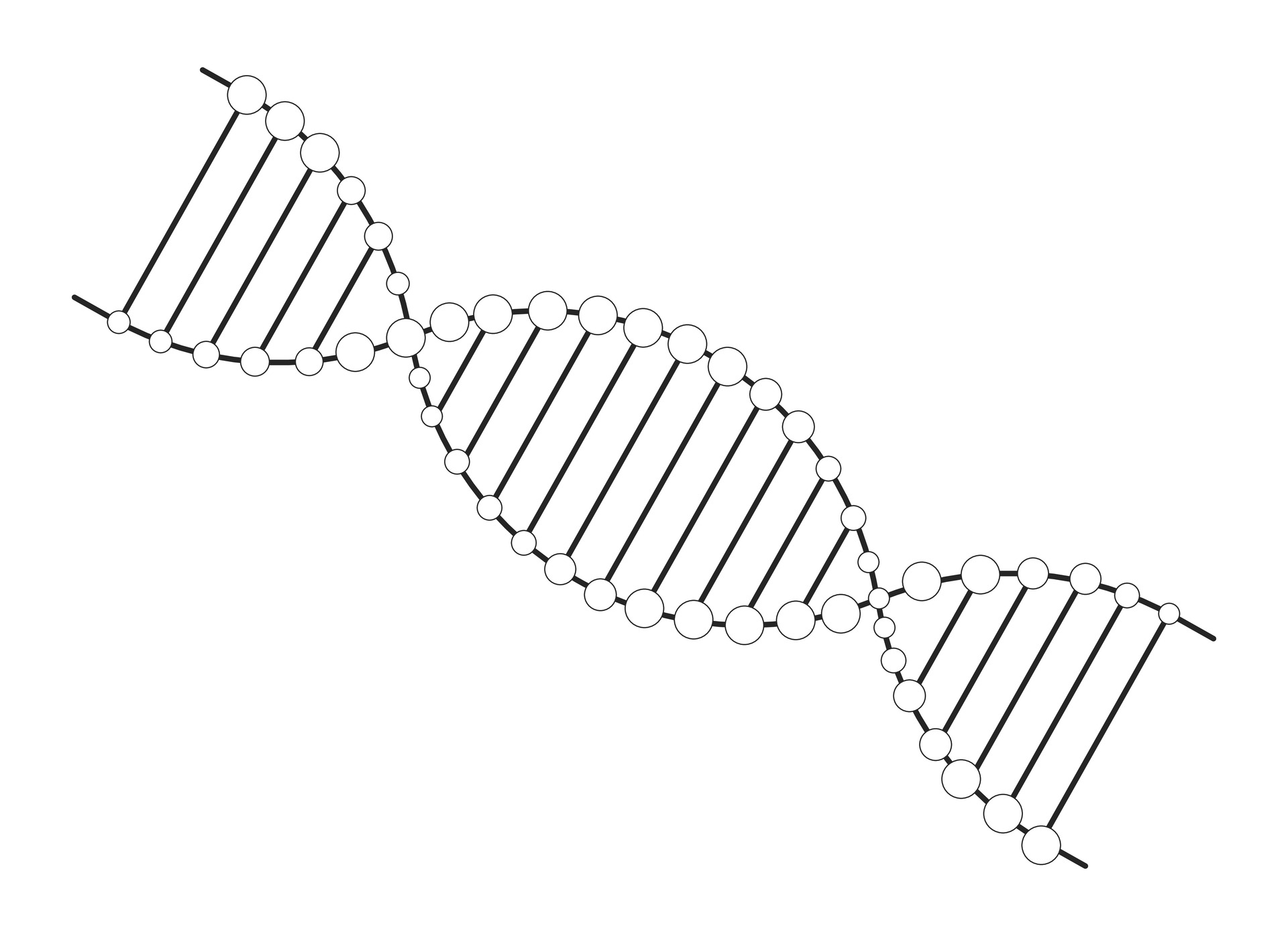
Inside each of those seeds is an instruction manual: its DNA, wound in a double helix, two strands twisted around each other. It is quite astonishing to me that this manual is written with only four letters. Four. Every living thing that has ever existed on this earth like the cedar and the sparrow and the whale and every one of us; all of it is spelled out with four letters and two strands.
Now being Jewish is also written on two strands: religion and peoplehood. Religion, as the strand where we find God, Torah, mitzvot, is the strand that reaches up, linking us to transcendent ideas like creation, revelation, redemption.
The other strand is peoplehood: family, history, language, culture. That strand reaches horizontally, linking us to each other.
And here is the thing about a helix: neither strand can hold its shape alone. Any strand of DNA needs its complement. The thing that is not the same as it, and that it cannot do without. Being Jewish is as infinite as DNA.
I want to tell you about a man who helped me think through this.
His name was Franz Rosenzweig. Born in Kassel in 1886, into a family so assimilated that he did not learn what Erev Shabbat was until he got to university. At eighteen he wrote to a friend that God, to him, was a weather maker. He was brilliant, he was German, he was on his way to a professorship, and by 1913 he had decided to be baptized – having received nothing from his family, he was looking for something.
Understand who was in the room with him. His cousin Hans, born a Jew, baptized as an adult. His cousin Rudolf, baptized as a child by his assimilated Jewish father who saw this whole Jewish thing just an impediment for the horizons of Rudolf. His friend Eugen, born to a Jewish family, converted as a teenager — and wanted to stand as Franz’s godfather at the baptism. One man who had left, one whose father had left for him, one who had left young and wanted company. Franz was the last of the cousins still holding the Jewish strand.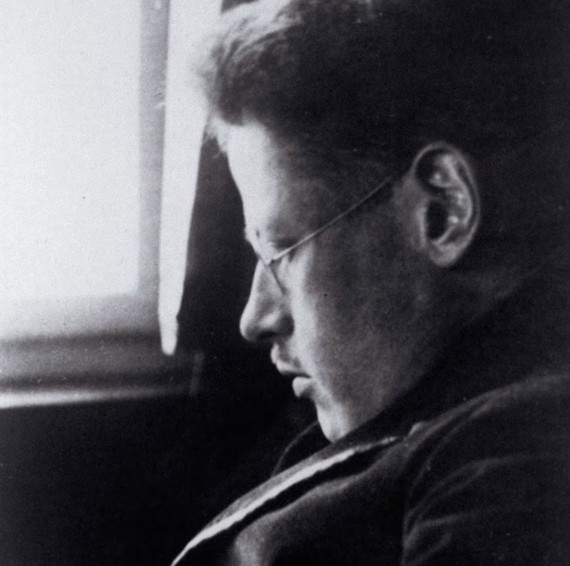
As philosophers do, they argued all night, and he lost. He agreed to be baptized. And then he made one condition. He said: I am not a gentile. I am a Jew. Let me look once at what I am leaving. Give me the days from Rosh Hashanah to Yom Kippur. He walked into a small Orthodox synagogue in Berlin as a man taking a last look. No one really knows what happened on that Kol Nidrei night, but he walked out with the decision of not converting. And what caught him was not a logical argument, full of proofs. No one had a “let’s talk Jewish theology” session with him on Kol Nidrei. What caught him was the people.
And then, on the thirty-first of October, he wrote a letter to his cousin Rudolf — the cousin who had been born Christian — and in it were four words: Ich bleibe also Jude. So I remain a Jew.
The people caught him first. The theology came after. That is the double helix in a single life.
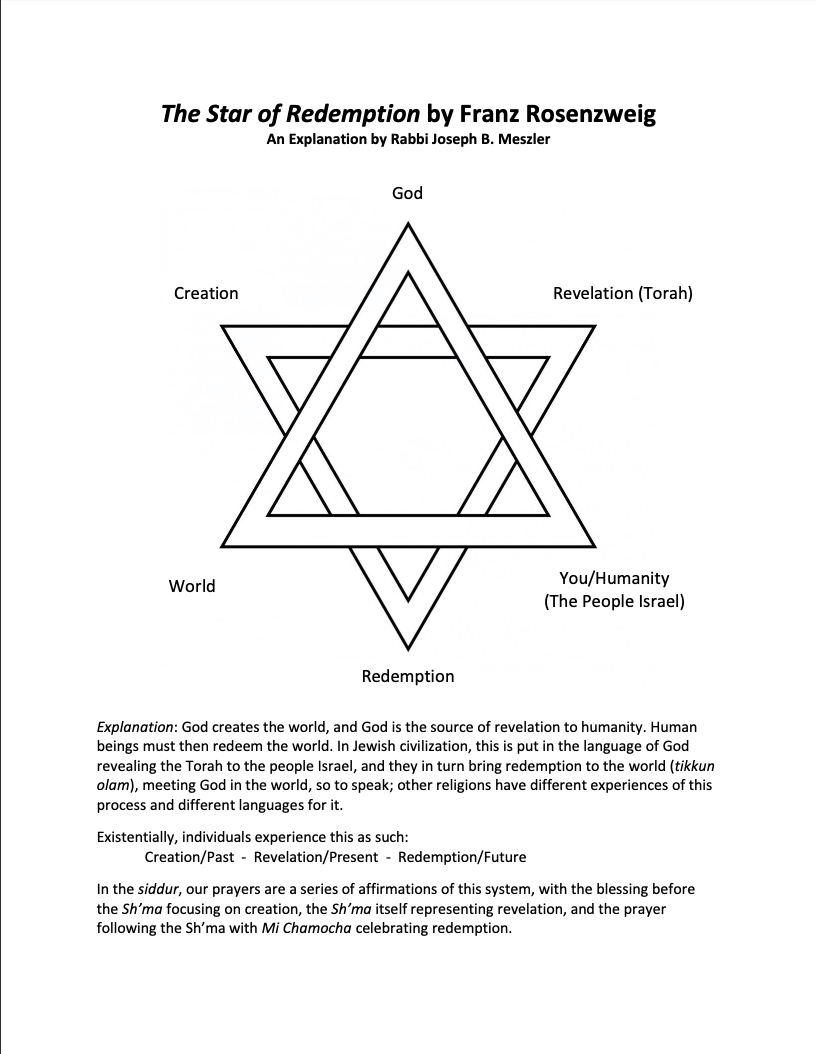
And what a theology. Over the next six years, much of it written on army postcards from the front and mailed home to his mother, Rosenzweig built one of the great books of modern Jewish thought. He called it The Star of Redemption — and the star of the title is two triangles. One triangle: God, world, self. The other: creation, revelation, redemption. Two strands, laid across each other. He drew a Magen David. That is a Jewish helix.
Now. The letters are few, but the sequences are endless.
Look around this room. Shabbat. Hebrew. Kashrut. Tzedakah. Israel. Mourning. Blessing. Study. Argument. Not one of us spells the same word out of them. Your Judaism and my Judaism are written in the same alphabet and they do not read alike, and that is not a failure of transmission. That is what a living thing looks like. A language in which everyone says the same sentences is a dead language.
Rosenzweig knew this from the inside. In 1922 he was diagnosed with ALS. He was thirty-five. Within a few years he could not speak, could not write, could move one finger and later only his eyes.
Before he got sick, he founded a dream: a Jewish house of learning in Frankfurt open to anyone at all — no exams, no references, no credentials. It was called Lehrhaus. It became a place to strengthen people under the Nazi regime, and was shut down for good in 1938. But the strand was picked up again, in Zurich in 1951, in Germany again in the eighties. Today you can access The Lehrhaus online and do what Rosenzweig dreamed: to grow by studying with other Jews, debating, learning, changing minds and having your own mind changed.
While battling ALS, Rosenzweig translated ninety-two poems of Yehuda Halevi, and began with Martin Buber a new translation of the entire Hebrew Bible. He got as far as Isaiah. All of it letter by letter, his wife Edith naming letters aloud and Franz signaling that one. He spelled out his life one letter at a time until the end.
He died in 1929, at forty-two. And Buber went on and finished that translation in 1961. That is exactly how a helix copies itself. It comes apart. And the strand that is left becomes the template for the whole.
That is what a generation is. It has happened to us after Babylon, after Rome, after Spain, after Europe. It happens in smaller ways in every family sitting in this room. Something comes apart, and out of what remains, a whole thing is built again.
Somewhere in those years, someone asked Rosenzweig whether he put on tefillin. His answer was: Not yet. Not no. Not yet.
[hold up the fruit] The seeds in this fruit were in the fruit that made the tree before it. And before that, and before that. Never the same, never a copy, and always recognizable. That is the seed of our people, and it is sitting in this room.
So in this year, 5787 — may the old and the new hold each other the way two strands do. May our Judaism be renewed and still recognizable. And if anyone should ask whether we have finished becoming the Jews we could be: may every one of us still be able to say, not yet.
Shehecheyanu v’kiy’manu v’higianu la-z’man ha-zeh. Shanah tovah.